
- Renervate
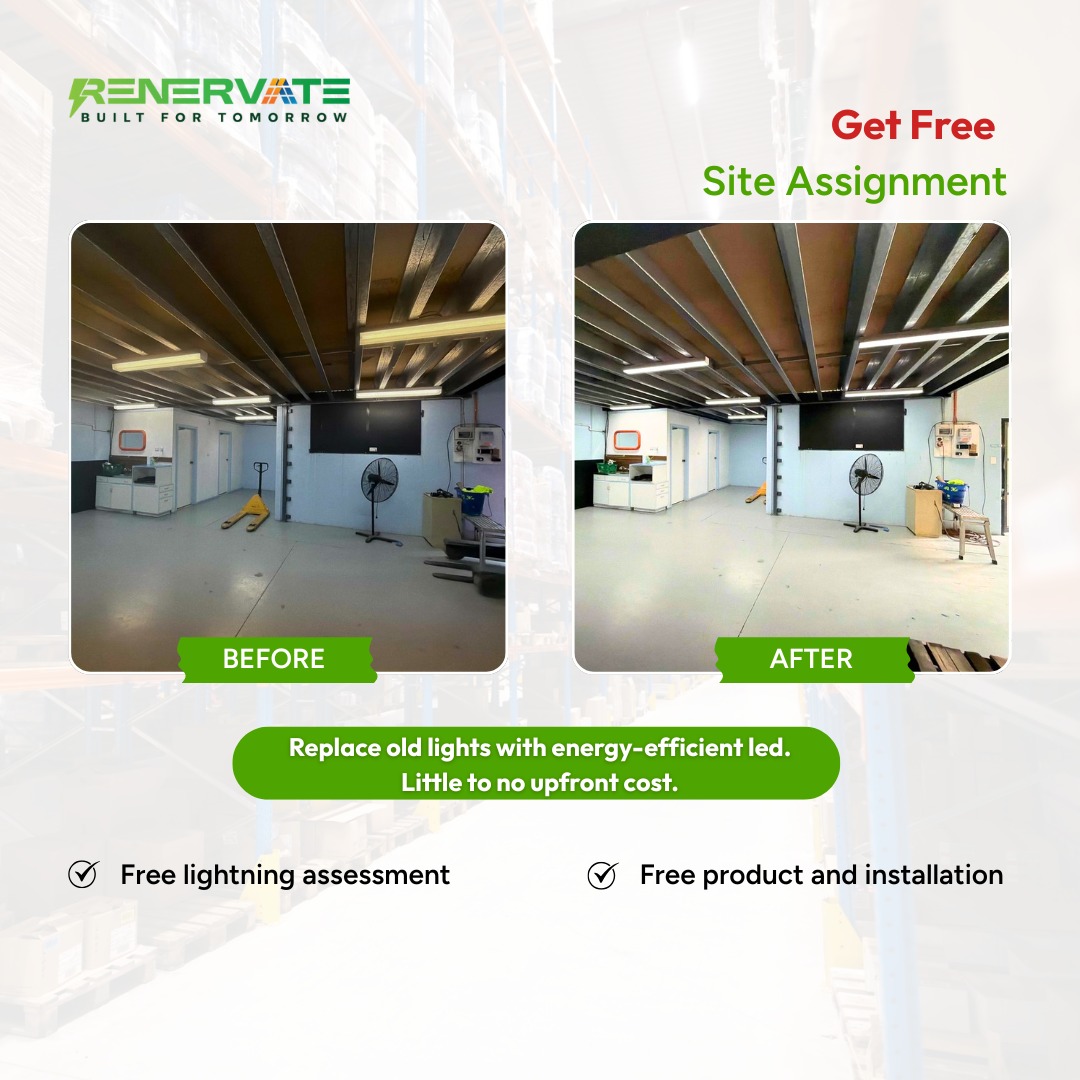
Say goodbye to dim, expensive warehouse lights! Switch to LEDs and illuminate your floors, enhance worker safety, and reduce energy costs with just one easy upgrade. Work smarter, brighter, and better. Warehouse and industrial facilities rely heavily on lighting to maintain productivity, safety, and smooth day-to-day operations. In large spaces with high ceilings, long operating hours, and constant movement of people and machinery, outdated lighting systems can result in excessive energy consumption, high maintenance costs, and poor visibility.
In addition to offering notable increases in productivity, cost savings, and sustainability, modern LED warehouse lighting systems are specifically designed to meet the unique requirements of industrial settings.
Understanding Warehouse Lighting Requirements
Step into any warehouse and the first thing you notice isn’t the shelves, it’s the light. But lighting isn’t just about visibility: it’s about meeting requirements that ensure safety, efficiency, and compliance. Get it wrong, and you risk accidents and wasted energy. Get it right, and your warehouse becomes a well‑lit engine of productivity.
Lighting in warehouses needs to be strong, consistent, and efficient. Poor lighting can create shadows between aisles, strain workers’ eyes, and increase the risk of accidents. On the contrary, LED lighting offers improved light dispersion, steady illumination, and instant maximum brightness. This makes it perfect for industrial facilities with high ceilings and spacious open spaces, such as warehouses and distribution centres.
Why LED Lights Are Ideal for Warehouses?
1. Energy Efficiency and Cost Reduction
Energy efficiency is one of the main reasons companies install LED lights in their warehouses. LED lighting fixtures provide superior brightness while using a lot less electricity than older lighting systems. Warehouses can usually cut lighting-related energy use by 50–80%. (Source: Commercial LED Lighting Guide 2025).
LED upgrades are an affordable long-term investment because lower energy use directly translates into lower electricity bills. Over time, the savings can be significant for warehouses that are operating 12 to 24 hours a day.
2. Longer Lifespan and Reduced Maintenance
Warehouse lighting fixtures are often installed at great heights, making maintenance costly and disruptive. Traditional lights may need frequent replacements due to shorter lifespans.
The normal lifespan of LED fixtures is between 50,000 and 100,000 hours, which significantly lowers the need for replacements. This decreases disruption, lowers maintenance costs, and lessens the safety risks of changing lights in high or difficult-to-reach places.
3. Improved Visibility and Workplace Safety
High-quality lighting plays a critical role in warehouse safety. LED lights clear shadows and dark areas between shelves and aisles by providing strong, consistent illumination. As a result, workers using forklifts, managing inventory, or carrying out intricate operations will have better visibility.
Improved visibility makes the workplace safer overall, lessens the chance of accidents, and eases eye strain. Many LED warehouse lighting systems are also compatible with emergency backup solutions, ensuring visibility during power outages.
4. Boosting Productivity and Operational Efficiency
Lighting quality directly affects employee performance. Poor lighting can lead to fatigue, errors in order picking, and slower task completion. LED lighting improves clarity and colour rendering, helping workers identify labels, products, and obstacles more easily.
Warehouses often report more efficient operations, fewer errors, and increased overall productivity when lighting conditions are optimised.
5. Sustainability and Environmental Benefits
Sustainability is becoming a priority for many businesses, and lighting upgrades are one of the easiest ways to reduce environmental impact. LED lighting supports sustainability by:
- Consuming less energy, which lowers carbon emissions
- Unlike many fluorescent lights, it doesn’t contain mercury.
- Producing less heat, reducing cooling requirements.
Businesses can greatly lower their carbon footprint and comply with regulations and sustainability goals by upgrading their warehouse spaces to LED lighting.
Types of LED Warehouse Lighting Solutions
Choosing the right LED lighting depends on your warehouse layout, ceiling height, and task areas. The ideal combination guarantees safer operations, improved visibility, and energy efficiency.
1.LED High Bay Lights for Warehouse
LED high bay lights are intended for high-ceiling warehouses. They offer wide-angle and bright illumination that guarantees uniform lighting throughout big open spaces. This enhances worker safety, lessens shadows, and boosts output. High bay LEDs are energy-efficient and have long lifespans, lowering both electricity and maintenance costs. (Source: TCP Lighting).
2.LED Tube and Linear Lights
LED T8 and T5 tube lights are often used to replace traditional fluorescent fixtures in aisles, shelving rows, and workstations. They provide consistent, uniform lighting, making it easier to locate products and complete tasks efficiently. LED tubes lower costs without sacrificing visibility because they use less energy and last longer than fluorescent tubes. (Source: LED Linear Tubes).
3.LED Strip and Area Lighting
LED strip lights are adaptable and ideal for narrow or concentrated spaces like workstations, shelving, or racks. They improve task-specific visibility, distribute light evenly, and minimise shadows. They are perfect for precise or detailed work areas because of their low-profile design, which enables installation in areas where traditional lighting might not fit.
Understanding the Shift from Traditional to LED Warehouse Lighting
In the past, many warehouses relied on fluorescent and metal halide lighting, which were easier to install but often failed to meet modern operational demands. Businesses eventually discovered hidden expenses and inefficiencies with conventional lighting systems that were not immediately apparent.
Key Forces for the Shift to LED:
1.Faster Start‑Up and Consistent Light Output:
Unlike metal halide lamps, which require time to warm up and reach full brightness, LED warehouse lights activate instantly with full illumination, improving operational readiness.
2.Directional Lighting Reduces Waste:
LEDs minimise wasted spill light on walls and ceilings by emitting light in a specific direction. This is particularly helpful in environments with tall hallways and high racks.
3.Enhanced Colour Rendering (CRI):
LED fixtures deliver higher colour rendering (CRI 80–90+), helping workers more accurately distinguish labels, packaging, and materials, which reduces errors in picking and sorting. (Source: CRI Explained).
4.Integration with Warehouse Automation:
LED systems can integrate with smart controls, sensors, and building management systems, enabling task‑based lighting, reduced energy waste, and automated responses based on activity.
5.Minimal Environmental Impact Beyond Energy:
Compared to fluorescent or HID lamps, LEDs have no mercury, emit very little UV radiation, and produce less waste over the course of their life expectancy, all of which minimise disposal challenges. (Source: Types of LED Warehouse Lighting).
The shift from traditional to LED warehouse lighting is not just about energy savings; it also improves worker comfort, visibility, operational effectiveness, and environmental compliance. LEDs are therefore a wise option for modern industrial facilities.
Installation and Implementation Strategy
Upgrading to LED lights for a warehouse requires careful planning to ensure maximum efficiency, safety, and cost savings. A strategic approach incorporates modern technologies like smart controls, minimises disruption, and optimises light distribution.
Key Steps for Effective Installation
1.Site Assessment and Layout Planning:
Examine warehouse ceilings, aisle widths, shelf heights, and workflow patterns in detail. Proper spacing and fixture placement ensure uniform light distribution and reduce dark spots or glare. Source: TCPI Warehouse Lighting Guide
2.Choosing the Right Fixtures:
Choose LED types according to the ceiling height and intended use, like LED strip/task lighting for shelving and packing stations, linear LED tubes for aisles, and high bay lights for tall storage areas. This ensures proper colour rendering and brightness in every zone.
3.Electrical Assessment and Safety Checks:
Verify existing wiring, load capacity, and compliance with electrical codes. Proper installation reduces the risk of short circuits, overheating, or downtime during retrofits.
4.Phased Installation Approach:
Implement LEDs in stages to avoid disruption of warehouse operations. Start with high-priority zones like loading docks, packing areas, and busy aisles, then gradually replace all fixtures. (Source: Warehouse Lighting Applications).
5.Integration with Smart Controls:
Install motion sensors, daylight sensors, and dimming systems to maximise energy consumption. These controls enhance sustainability while ensuring lights operate only when needed.
6.Testing and Optimisation:
Check lighting levels, consistency, and sensor performance right after installation. Adjust angles, brightness, or spacing if necessary to achieve ideal illumination and maximise safety and productivity.
The Feature of Warehouse Lighting
Warehouse lighting is evolving into smart, energy-efficient, and sustainable systems that do much more than illuminate. The market for energy-efficient warehouse lighting is predicted to grow to $42.5 billion by 2033 due to the increasing use of integrated controls and sophisticated LED solutions. IoT-enabled smart lights are already providing real-time data on occupancy, energy usage, and maintenance needs, paving the way for AI-powered predictive lighting by 2040, which can automatically adjust brightness, anticipate fixture failures, and improve workflow efficiency.
Haitz’s Law predicts that by 2050, LEDs will provide more lumens per watt at a lower cost, making ultra-efficient lighting standard in warehouses across the globe. Adaptive colour temperature, Li-Fi data transmission, and energy-tracking dashboards are examples of future innovations that could help warehouses meet long-term sustainability objectives, increase safety, and cut down on energy waste.
Upgrade Your Warehouse with Renervate LED Lighting Solutions
Upgrading your warehouse with Renervate LED lighting solutions means choosing high‑performance, energy‑efficient fixtures designed for industrial settings. Renervate offers a range of LED high bay lights suited to warehouses with tall ceilings and expansive storage areas. The ERS LED Highbay lights have an ultra-efficient output, built-in motion and daylight sensors, and a five-year warranty to guarantee reliable performance for years to come. Moreover, for spaces requiring high lumen output and durability, LED UFO High Bays deliver stable, flicker‑free brightness with excellent colour rendering and a long service life, helping improve visibility and safety across aisles and work zones.
Partnering with Renervate also means personalised support, including free quotes and tailored lighting plans, to reduce energy costs and optimise warehouse operations.
FAQs
What kind of lighting works best in a warehouse?
Round high bay LED lights are ideal for large, open areas due to their wide beam spread and high lumen output. A combination of linear high bays and LED strip lights might be more suitable for warehouses with different ceiling heights or particular task areas to guarantee uniform lighting throughout.
Is 3000K or 4000K better for the office?
It is best to use 3000K if you want to create a warm, comfortable space for casual use. You should choose 4000K if you want an energising light that increases productivity. You can create the perfect balanced environment for different tasks if you combine both in different areas of the office.
Do LED warehouse lights improve safety?
LED lights provide instant brightness, lessen shadows, and increase visibility, all of which contribute to increased operational safety and minimise accidents in the workplace.
How much can warehouses save on energy costs with LED lighting?
A warehouse can save between $5,000 and $20,000 annually on electricity, depending on its size, ceiling height, and operating hours, by using LED high bay lights and energy-efficient fixtures.
Do LED lights support emergency or backup lighting?
Yes. Many LED warehouse lights can be integrated with emergency battery packs, ensuring visibility during power outages or evacuation situations.
What is the ROI of upgrading to LED warehouse lighting?
Most warehouses see a return on investment within 1–3 years due to lower energy bills, reduced maintenance costs, and longer fixture lifespans.